
Lee County Deed Records and Instruments
Deeds in Lee County are recorded by the Clerk of Circuit Court. That office keeps the county's land-record books. The public index reaches deeds, deeds of trust, releases, plats, financing statements, judgments, probate, and court records. A deed conveys an interest and names its parties. A deed of trust or lien burdens the land instead. A release or certificate of satisfaction can show that burden was later discharged, so search by the instrument type and parties that actually appear.
| Deed Type | What It Does | Common Use |
|---|---|---|
| Deed | Records a transfer or other land interest | Follow a change in ownership |
| Deed of trust | Records a secured loan instrument | Check an encumbrance in the land trail |
| Release or satisfaction | Records discharge of an earlier instrument | Match it to the related lien or deed of trust |
| Special commissioner deed | May follow a court-supervised sale | Check the sale authority and later filings |
| Plat | Shows a recorded lot or tract layout | Read with the deed description |
Read Lee County deed records as a sequence. The newest deed names a grantee and usually points back to a prior owner. Other instruments can affect the same parcel without moving title. The reference and legal description keep the categories straight.
Lee County SRA Index and Images
The Clerk links its search to Virginia Secure Remote Access. Its free index needs no login. Document images go only to subscribers the local clerk authorizes. Access runs under an agreement and applicable fees. The Clerk posts no Lee cutoff date. An empty image panel therefore does not prove a deed was never filed. Take the party name and recording reference to the courthouse. Ask there for the record itself. These are the search details that matter:
| Search key | Form type | Required | Lee County status |
|---|---|---|---|
| Grantor | Party name | Not verified | Expected index key; exact label not rendered |
| Grantee | Party name | Not verified | Expected index key; exact label not rendered |
| Document type | Dropdown | Not verified | Full list was not visible |
| Recording date or book/page | Date range or paired reference | Not verified | Use a clerk citation if you have one |
Read the Virginia Courts SRA access rules for the free-index and subscriber-image split.
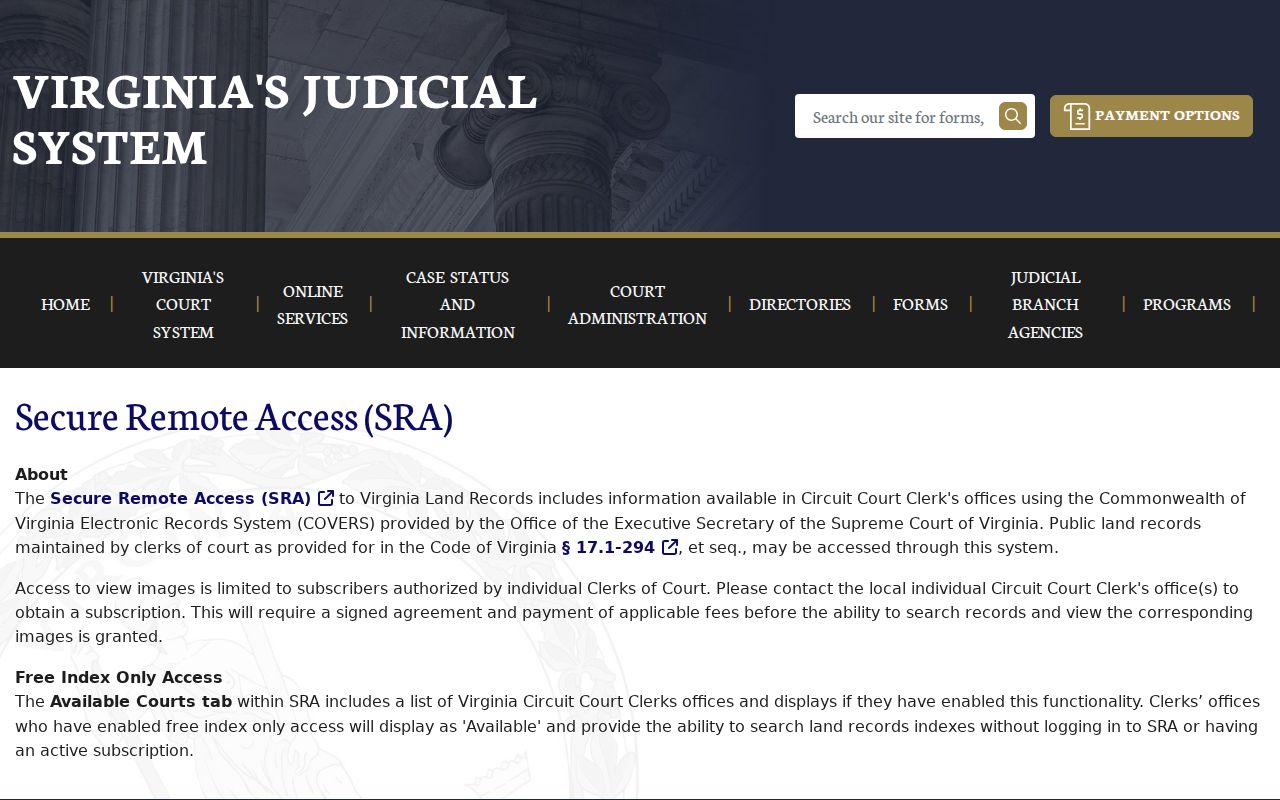
The remote index can still identify a filing when the Clerk must be asked for the image itself.
Lee County Deed Books Since 1793
Lee County was formed from Russell County in 1792. The Circuit Clerk dates the clerk institution to 1793. That is context, not coverage. The public pages name no first deed book, volume runs, or imaging start date. Ask the Clerk which earliest index or book covers the tract you are tracing. Older parcels take patience. Bring the present deed's legal description, map reference, and prior deed citation to the public records room. Search the grantor and grantee indexes backward. Ask as well whether microfilm or an archive copy covers a volume missing from SRA. The Library of Virginia can point to state-held material and finding aids. The Lee Clerk is still the first stop for original county deed books. When the name trail breaks, try probate records. An executor or heir transfer often shows up there. The recorded instrument, not a family story or tax ticket, is what ties the next owner to the land.
Reading Lee County's Party Index
Virginia SRA indexes land records for participating courts. The county publishes no list of Lee search labels, document types, or online start year. Start from a known grantee or grantor name. Keep each result's recording date and reference. When the remote record stops, ask the Lee Clerk for an image or the older book. Names wander, though. A person may appear under a changed spelling, an entity, a trustee, or an estate name, so compare the parcel description as well as the party.
- Find the newest deed reference for the parcel and note the grantee, recording date, and legal description.
- Read the grantor, the party who transferred the interest, and use that name as the next grantee search.
- Repeat until a name, date, or legal description no longer matches the same tract. Keep a separate line for each instrument.
- When the remote index has no older result or image, ask the Clerk which deed book or index to inspect.
- Grantor
- The party who conveys or transfers an interest.
- Grantee
- The party who receives the interest.
- Chain of title
- The sequence of recorded instruments that traces a parcel through transfers.
- Book/page or instrument number
- A clerk reference used to locate a filed record; Lee's exact online display depends on the index.
Lee County Land Record Filing Rules
Lee County's land-record rules start with the document itself. Instruments must be original, signed, and notarized. They must also show venue and notary registration or seal information. Virginia also requires a Land Record Cover Sheet under Code section 17.1-227.1. The Clerk accepts electronic recording through Simplifile and CSC. Filers are directed to the state's deed-calculation site for deed calculations. These rules matter when a submission is rejected. They matter just as much when a new document must be recorded. No single recording price covers every instrument. Recording taxes and fees depend on the document type. Keep the recording charge apart from the clerk's copy charge. A remote image subscription, where the clerk authorizes one, is a separate cost as well. Review the Lee County Clerk land-record page for current filing steps.
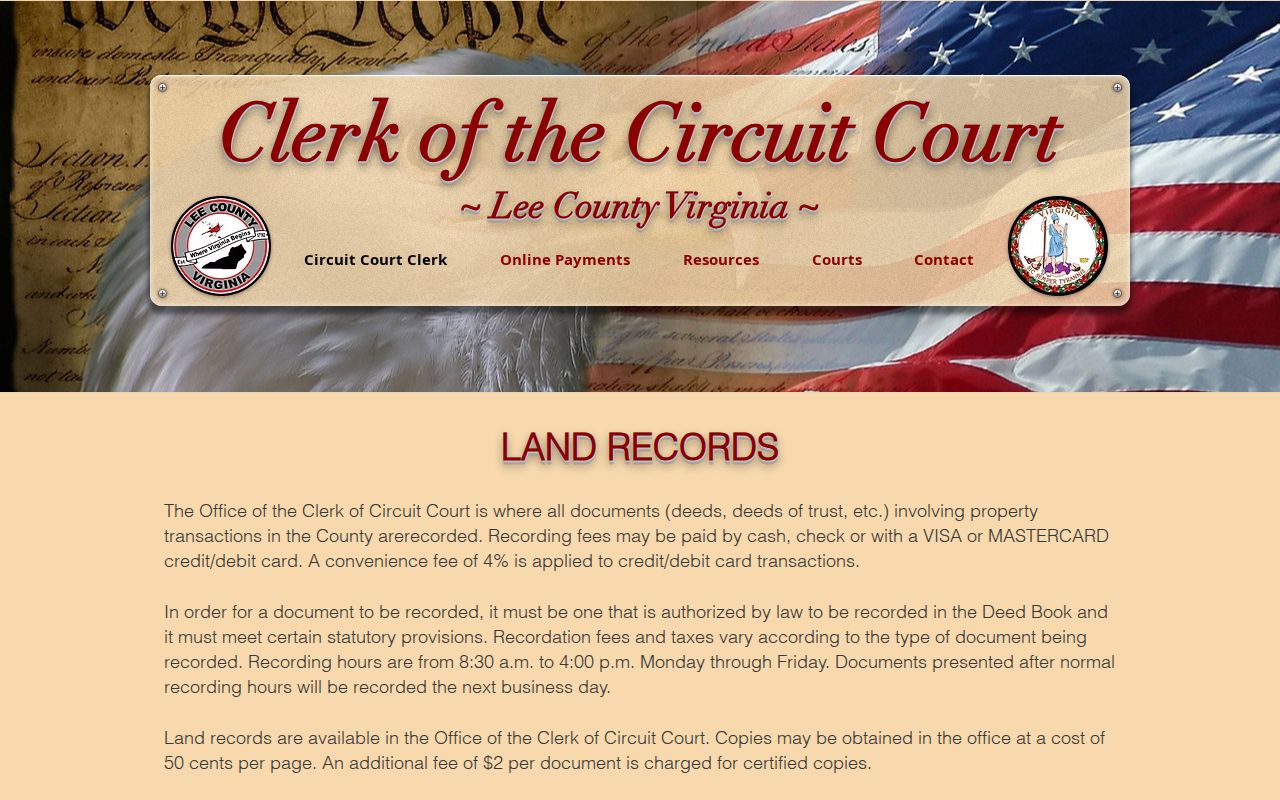
The local page lists the cover sheet, e-recording vendors, office hours, and copy fees.
Lee County Deed Copy References
Inside the land-record system, a book/page citation or electronic instrument number works like the address of a document. It points straight to one recorded deed. Record the full reference, the party names, the instrument type, and the recording date together. Those details let the Clerk pull the deed without guessing. A street address alone will not do it. The office sits at 33640 Main Street in Jonesville. It takes recording documents on weekdays from 8:30 a.m. to 4:00 p.m.
Copies in Lee County run 50 cents per page. Certification adds $2 per document, and card payments carry a 4% convenience fee. That fee table covers copies at the Clerk, not recording taxes or subscriber image access. Before mailing a request, ask which record format the office uses. Include the book/page or instrument number when you have one.
Reach the Clerk at (276) 346-7763, P.O. Box 326, Jonesville, VA 24263. After-hours filings move to the next business day, per the clerk's page.
Lee County Deeds of Trust and Releases
A deed of trust lives in the land-record trail. It does not transfer ownership the way a deed does. Lee County's Clerk tracks several public record categories. These include deeds of trust, releases, financing statements, and judgments. Start with the parcel's owners and the land description. Then pair each recorded burden with a later release. Look for a certificate of satisfaction or court disposition where one exists.
An old deed of trust may sit in the index. That does not mean the loan is still open. A missing online release does not prove the debt is unpaid either. Ask the Clerk for the image and read the instrument itself. A judgment or mechanic's lien may also have a separate civil case. An easement or covenant may hide inside a deed or a recorded plat. Need the full reverse chain? The Lee County former-owner search explains how to walk from grantee back to grantor.
Lee County Tax Sale Deeds
The Treasurer's Tax Auction page posts notices and sale images covering delinquent-tax and special-commissioner sales. No text search is offered there, and no coverage period is stated for the notices. Treat a sale image as a lead, not a substitute for the recorded deed and the court or commissioner authority behind it. Match the parcel ID and legal description before linking any notice to a tract.
Search the Clerk's land records for a special commissioner deed, later conveyances, and any release or order tied to the same parcel. Lee Circuit Court civil files can add context where a foreclosure, partition, or tax-sale dispute went before a judge. For the current list or sale status, contact the Treasurer at (276) 346-7716, since the public page shows no active inventory.
The Lee County Treasurer auction page is the official notice source.
Verify a listed sale against the Clerk's record before relying on a tax-sale reference.
Lee County Court Cases and Deeds
Foreclosure, quiet-title, partition, probate, judgments, and specific-performance matters can explain why an executor or special commissioner signed a deed. Virginia Case Status and Information offers a statewide case index. Local files live at Lee Circuit Court. The search is dynamic, and its field labels and result format vary. Note the case number, party names, case type, filing date, status, and hearing entries that the live record displays.
A docket is not a land instrument. Request the local pleading or order from the Clerk, then compare it with the deed and legal description. Probate requires an appointment, per the court's local page. Sealed or protected files are not general public records. The state case-information search is the index route.
Use the result to identify the file. Then ask the Lee Clerk for the court record that affects the deed chain.
Getting a Lee County Deed Copy
For an accessible SRA image, follow the portal's subscriber instructions. Confirm Lee County access with the Clerk. If the image is not available, visit or contact Lee Circuit Court Clerk at P.O. Box 326, Jonesville, VA 24263, or call (276) 346-7763. Recording hours run 8:30 a.m. to 4:00 p.m. on weekdays. Documents received after hours are handled the next business day.
Ordinary copies cost 50 cents per page. A certified copy adds $2 per document. A card payment carries a 4% convenience fee. Recording taxes and fees vary by document. Do not mistake a copy charge for a filing charge or an SRA image subscription price. Ask the Clerk what reference and payment method a request needs before you send it.
Recorded, not guaranteed. Lee County deed records show filed instruments, not every possible interest or the legal effect of each clause. A title search by a qualified professional is needed to assess the full chain.