
How Lee County Property Records Fit Together
Three public channels hold most of what you need. The Commissioner of the Revenue links to Property Card Search. It covers assessment details and tax-map clues. The Clerk of Circuit Court records deeds, deeds of trust, releases, and plats. The Treasurer bills and collects the real-estate taxes. GIS mapping ties a parcel to the ground. Building and zoning files show whether work or land use got county approval. An address is a fine starting point. The tax map number and legal description work better as handoff keys between offices.
Write down the owner name exactly as printed. Include the situs address, any separate mailing address, the tax-map ID, and the deed book and page or instrument number. Those details help the next office separate your parcel from a same-name result. The roll and the map are evidence, but only that. Neither one replaces the newest recorded deed. Nor does it replace a fresh boundary survey for a Lee County property search that turns on legal detail.
- Start at Lee County Property Card Search with an address or owner name. The live field labels were not confirmed, so call the Commissioner if the portal does not find a rural address.
- Ask the Commissioner of the Revenue for the tax-map number or tax ID when the card is hard to locate. That number is the bridge between assessment and GIS records.
- Carry the owner name and parcel description to the Clerk's land-record index. Confirm the most recent deed and note its recording reference.
- Use the Treasurer's tax page for bill rules and the county GIS for map context. A map line is not a surveyed boundary.
Offices Behind Lee County Property Records
Each office in Lee County owns one slice of the land trail. The Circuit Court Clerk serves as recorder and courthouse custodian. The Commissioner of the Revenue handles assessment and mapping. The Treasurer sends out and collects the tax bills. Building and zoning questions go to Room 206 at the courthouse. Start with the office that holds your record type. Let that staff point you to the right book, parcel, or case reference.
Lee Circuit Court Clerk
33640 Main Street
Jonesville, VA 24263
(276) 346-7763
Lee County Treasurer
County tax-bill and collection office
Jonesville, Virginia
(276) 346-7716
Lee County Property Card Search
The county website links to the Commissioner of the Revenue's Property Card Search, a live tool for pulling assessment cards by parcel. Its search fields and result layout follow the Commissioner's own design, and the county says the office can locate a tax map number or tax ID by search or by phone. When an address returns no clear match, call (276) 346-7722 with the road name, the owner's spelling, and any old deed reference you hold.
Treat a returned owner name as an assessment clue first. Check its date against the recorded deed before relying on it. The tax ticket carries its own July 1 owner-of-record date, so a transfer recorded after that date can post to the roll before the next tax year while the older name stays on the current bill. Assessment cards may show a last sale, a sketch, land value, or exemption flags depending on the parcel.
| Card item | Research status | Useful next step |
|---|---|---|
| Owner name and mailing address | Search/result labels not visible | Compare with the newest deed |
| Situs and tax-map ID | Exact field names not confirmed | Ask the Commissioner for the county key |
| Values, exemptions, sketch, sale | Card layout not inspected | Verify what the live record displays |
Lee County Assessment Dates and Tax Bills
The Commissioner sets fair market value through a sales study and generally reassesses each parcel every six years. The latest general reassessment became effective January 1, 2025; the county identifies tax year 2031 as the next expected cycle. The Treasurer's real-estate tax page lists the rate as $0.69 per $100 of assessed value, with bills due May 31 and October 31. A bill is a tax account record, not the recorded ownership instrument.
Late payment carries a one-time 10% penalty and interest at 10% per year, applied monthly. The 2025 hybrid schedule separates the date rates take effect from the owner date used on the tax ticket: rates take effect January 1, while the owner of record is fixed as of July 1. This means a deed recorded after July 1 may not change the name on that year's ticket.
For assessment timing and the fair-market-value method, read the Commissioner's 2025 reassessment and value FAQ.

The six-year schedule describes the county's assessment cycle as a whole, not a parcel-specific appraisal. Check the Treasurer's current bill rules for due dates and the posted rate.
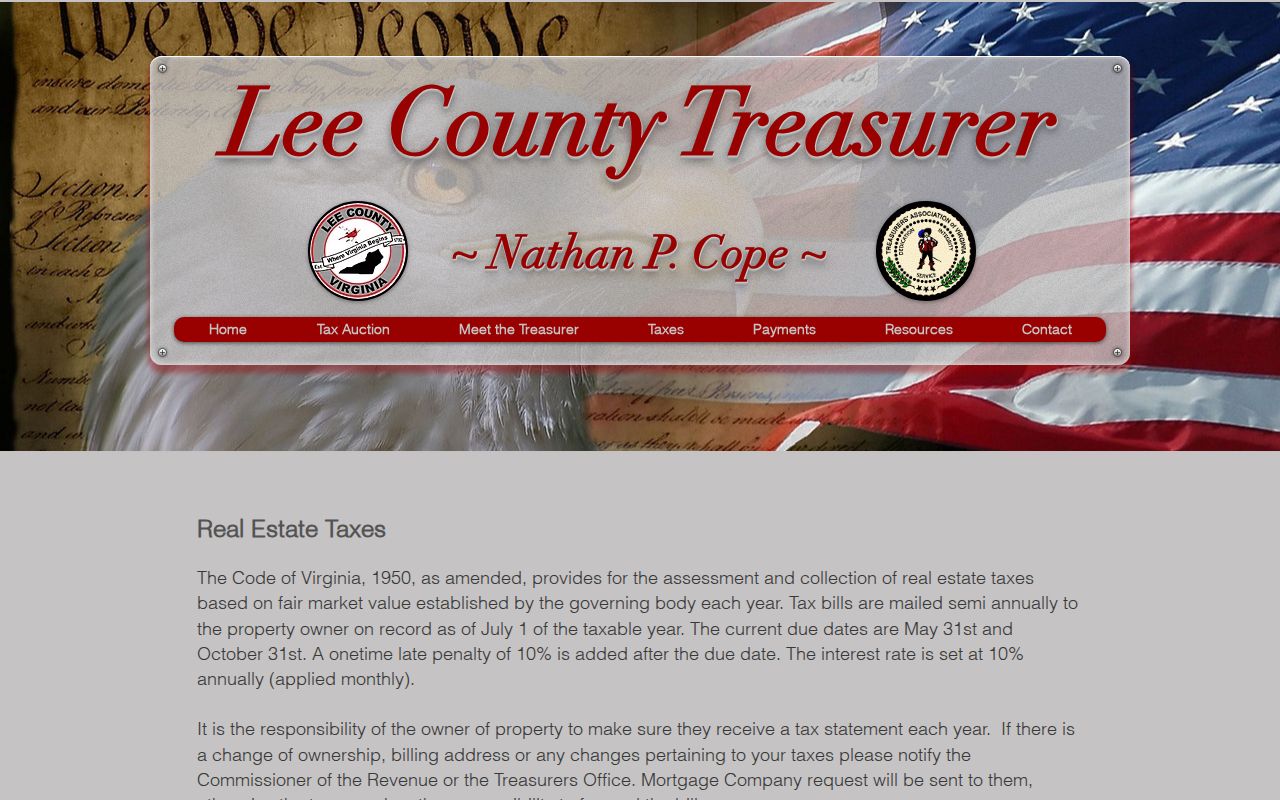
The tax page covers collection rules; the assessment value itself comes from the Commissioner of the Revenue.
Lee County's Deed Index and Old Books
The Clerk of Circuit Court records deeds, deeds of trust, releases, plats, financing statements, judgments, probate, and other court matters. Recordation requires original signed and notarized documents plus a Virginia Land Record Cover Sheet. E-recording runs through Simplifile and CSC. For public lookups, Virginia SRA may expose a free index for an available court. Document images require clerk-authorized subscriber access or a visit to the counter.
Lee County publishes no clear cutoff for how far its online material reaches. The clerk's office dates from 1793. That long history is no promise that every older deed image is online. Start from your most recent deed reference. Ask the clerk which book or index to consult. Do this once the chain moves earlier than the digital material. In-office copies cost 50 cents per page, and certification adds $2 per document. Review the Lee County Clerk land-record page for its current counter and copy instructions. The Virginia Courts SRA access page explains the remote index and image-access routes.
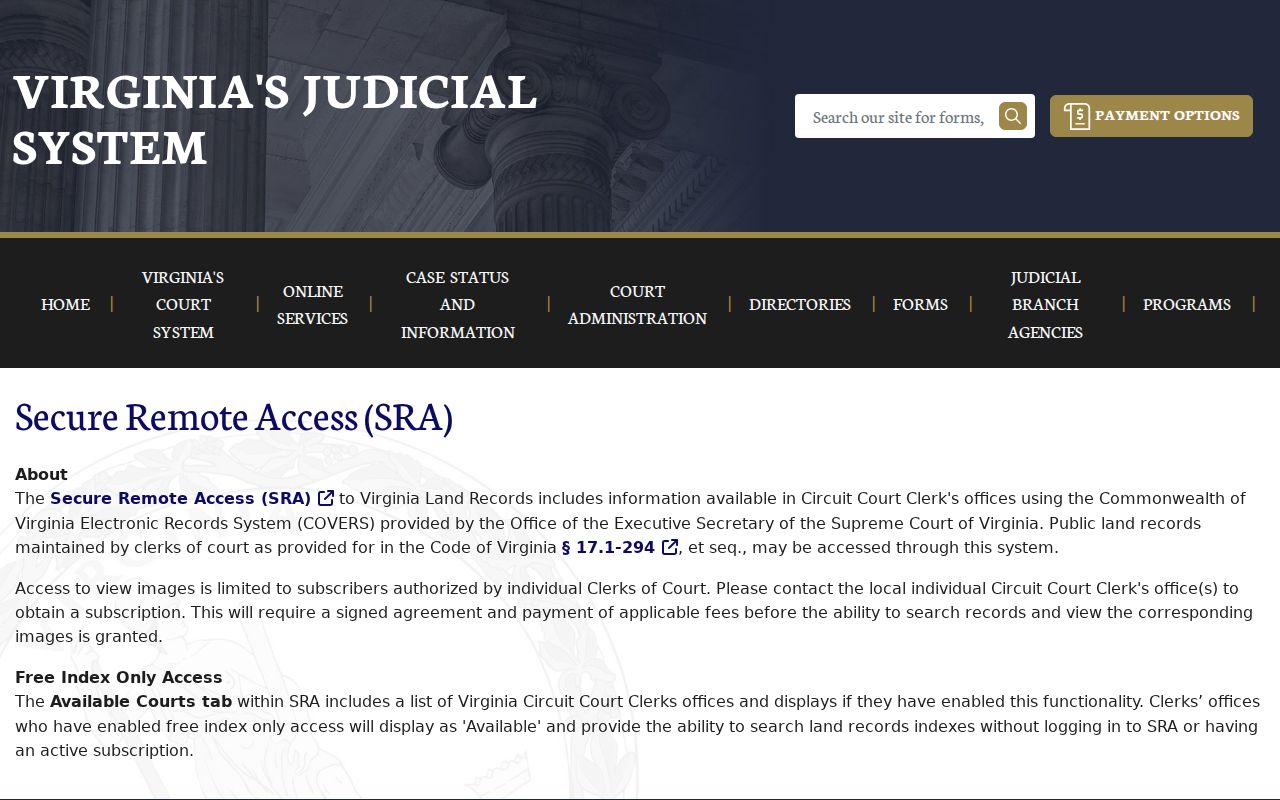
An index entry can pinpoint a filing even when the deed image itself must be requested at the counter in Lee County.
Check the Lee County Clerk land-record page for current counter hours and copy instructions.
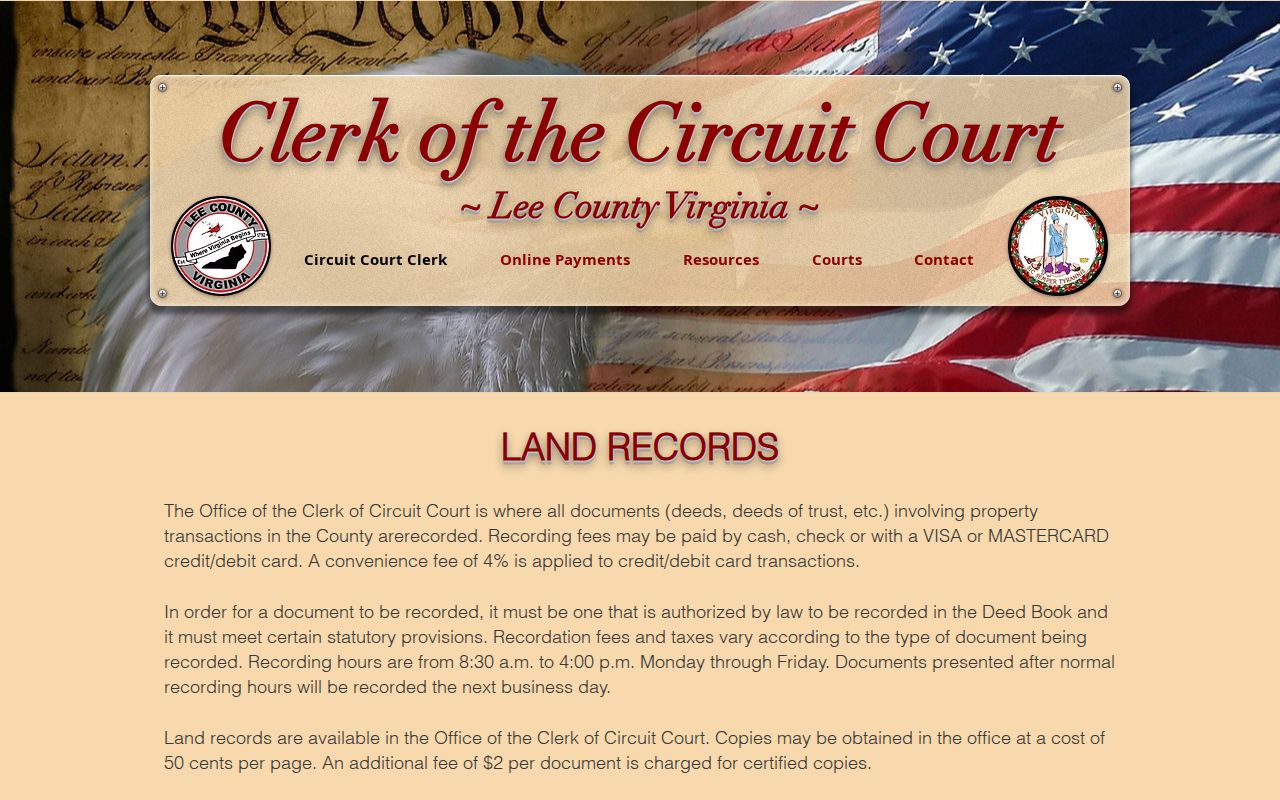
When the index shows a filing but no image, the clerk's page gives the local counter route for Lee County deed records.
Lee County Civil and Probate Files
Some property questions end up in a courtroom. Lee Circuit Court handles foreclosure, quiet title, and partition. It also handles probate, judgments, and sales authorized through an estate or a special commissioner. The statewide Virginia Case Status and Information portal works as an index route. The case file itself stays with the Circuit Court Clerk. The portal publishes no sample result or field list. So hold onto a case number. Ask the clerk about file status and available pleadings.
Probate requires an appointment, per the Lee Circuit Court page. A docket can explain an executor-signed deed. It can also show why title moved through a case. Still, the land instrument and its legal description tie the action to a tract. Sealed, juvenile, and protected matters stay off public lookup.
Start with the Lee Circuit Court clerk information or the state case portal.
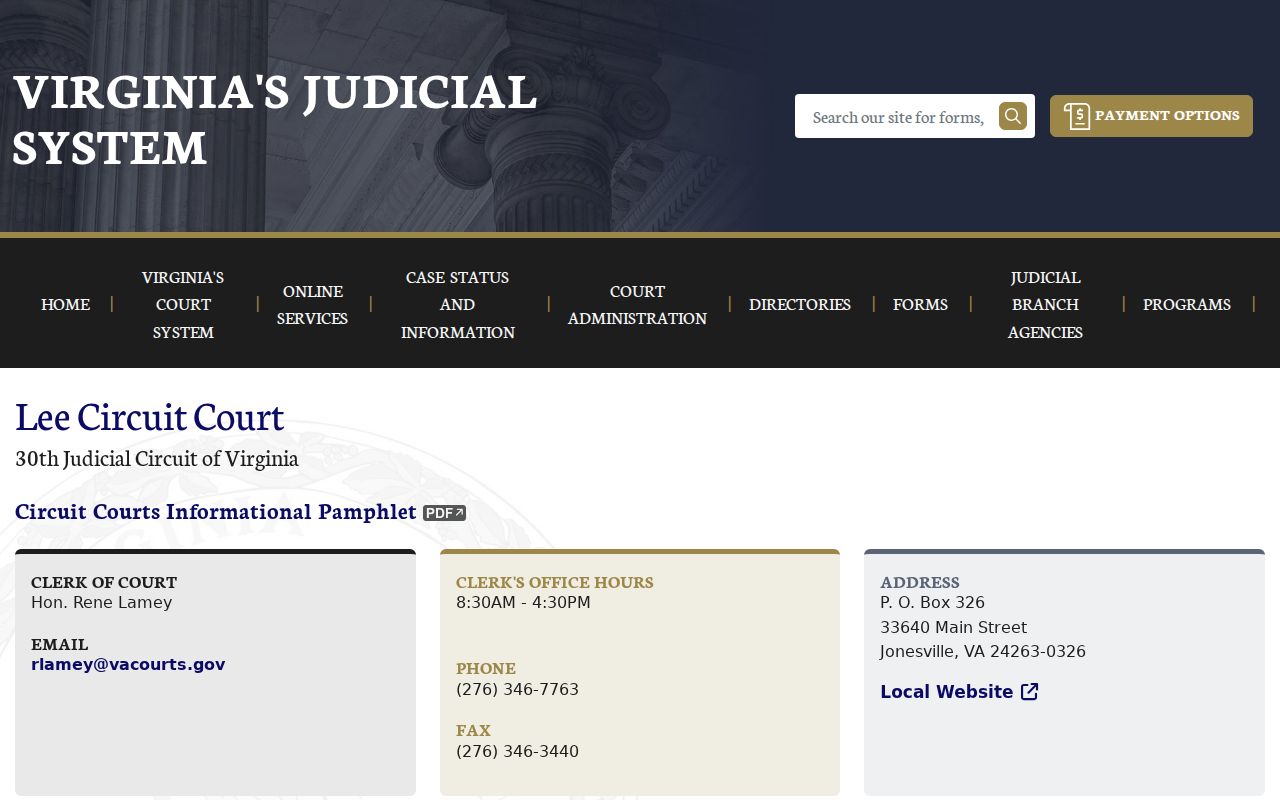
The court contact page confirms the local route. Lee County's clerk handles any case tied to a property transfer.
Lee County Property Records by Type
Lee County property records is an umbrella phrase, not one master file. A deed records a transfer or interest. An assessment card links parcel and value details. A Treasurer record shows billing and payment rules. A recorded plat describes a lot layout, while GIS gives a visual reference. Permit and zoning files can explain improvements or land-use approvals, but Lee County offers no online permit-result search.
| Record Type | What It Documents | Kept By | Access |
|---|---|---|---|
| Deeds and releases | Transfers, liens, deeds of trust, plats | Lee Circuit Court Clerk | SRA index, subscriber images, or counter copies |
| Assessment card | Owner and tax-map clues, assessed value, exemptions | Commissioner of the Revenue | Property Card Search or office help |
| Tax bill and sale notice | Due dates, late charges, tax-auction notices | Lee County Treasurer | County web pages, phone, or office |
| Parcel and plat | Map position, lot layout, legal description | County GIS and Clerk | Interactive viewer plus recorded instrument |
| Permit and zoning file | Construction, inspection, variance, and land-use approval | County Building Safety and Zoning | Paper application, counter, or records request |
Who received title? The deed controls that question. For what the county assessed, use the Commissioner. The Treasurer holds bill dates and delinquency notices. The Lee County deed records page walks the grantor and grantee trail, while GIS and plat records answer a spatial question instead.
Lee County GIS Is a Reference Map
The Commissioner of the Revenue's Mapping and GIS page links to Lee County's InteractiveGIS viewer. The public-access page notes a data update on September 4, 2026. Its terms still call the map general reference material. Measurements run approximate. Parcel outlines and district lines may lag. Recorded deeds and plats control legal acreage and ownership. A fresh map timestamp never turns a parcel edge into a survey.
Use the viewer to spot a likely parcel. Then carry the tax-map ID to Property Card Search. Carry the legal description to the clerk's recorded instrument. The county does not document live layer names, address-search fields, adjacent-parcel tools, exports, or a parcel-number format. Plan to explore the viewer directly. Where a boundary or split matters, ask the Commissioner and compare the recorded plat. Do not trust a screen measurement.
Open the county's Mapping and GIS entry page. Then follow the Lee County GIS public-access link to the interactive viewer.
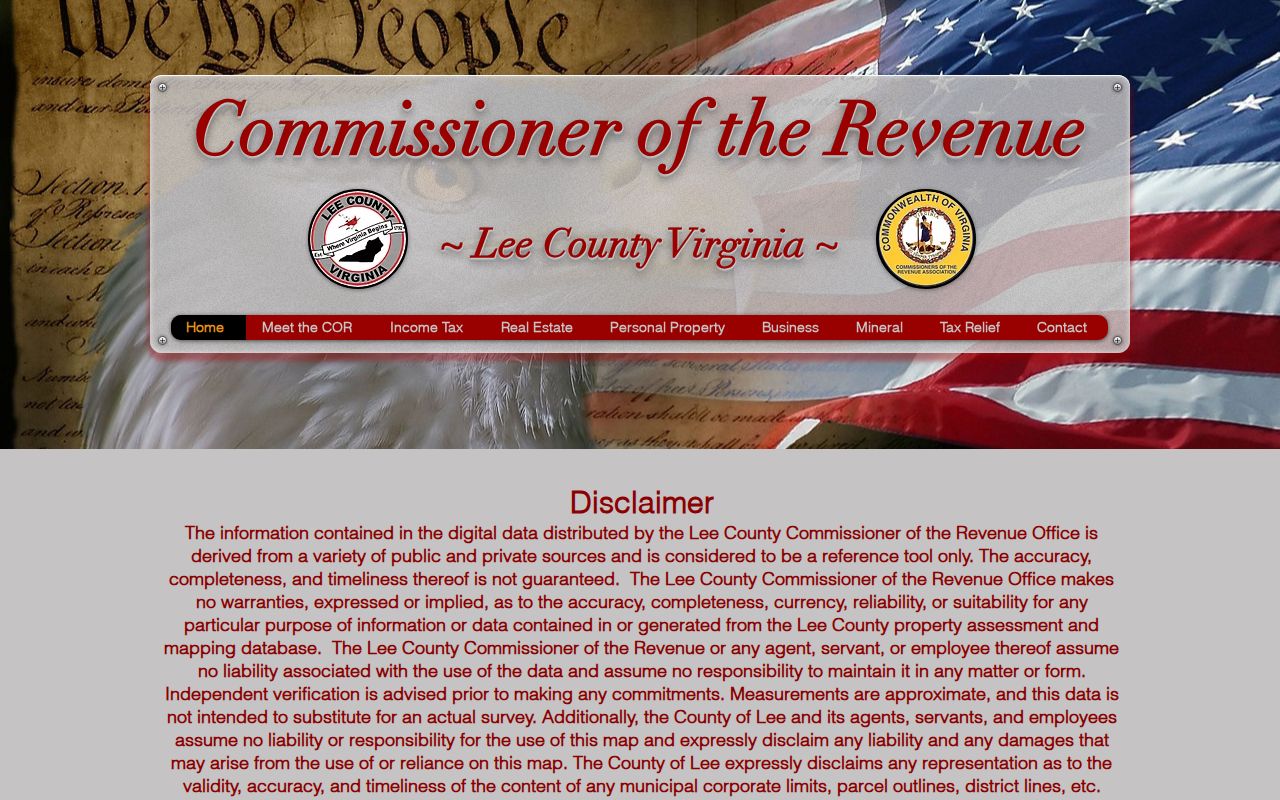
The landing page is the route to the viewer and states the reference-map limits.
Lee County Zoning and Permit Files
The Lee County Zoning Department sits in Room 206. A zoning permit requires a printed application, a recorded deed copy, and a $20 fee. New construction, additions, major renovations, and manufactured homes are among the listed permit triggers. A variance request needs an application, deed, and adjacent-owner list, with residential fees of $100 and commercial fees of $150. Special-use requests carry the same fee amounts. Rezoning and text changes follow separate filing requirements.
Lee County advertises no online permit-result database. Call Building Safety and Zoning at (276) 346-7715 or visit the office to ask which file covers an address. For unincorporated parcels, the county serves as the practical building and zoning desk. The towns publish no searchable permit portal either, so a map or town name should not be read as an approval record. The Lee County Zoning Department instructions list the local filing requirements.
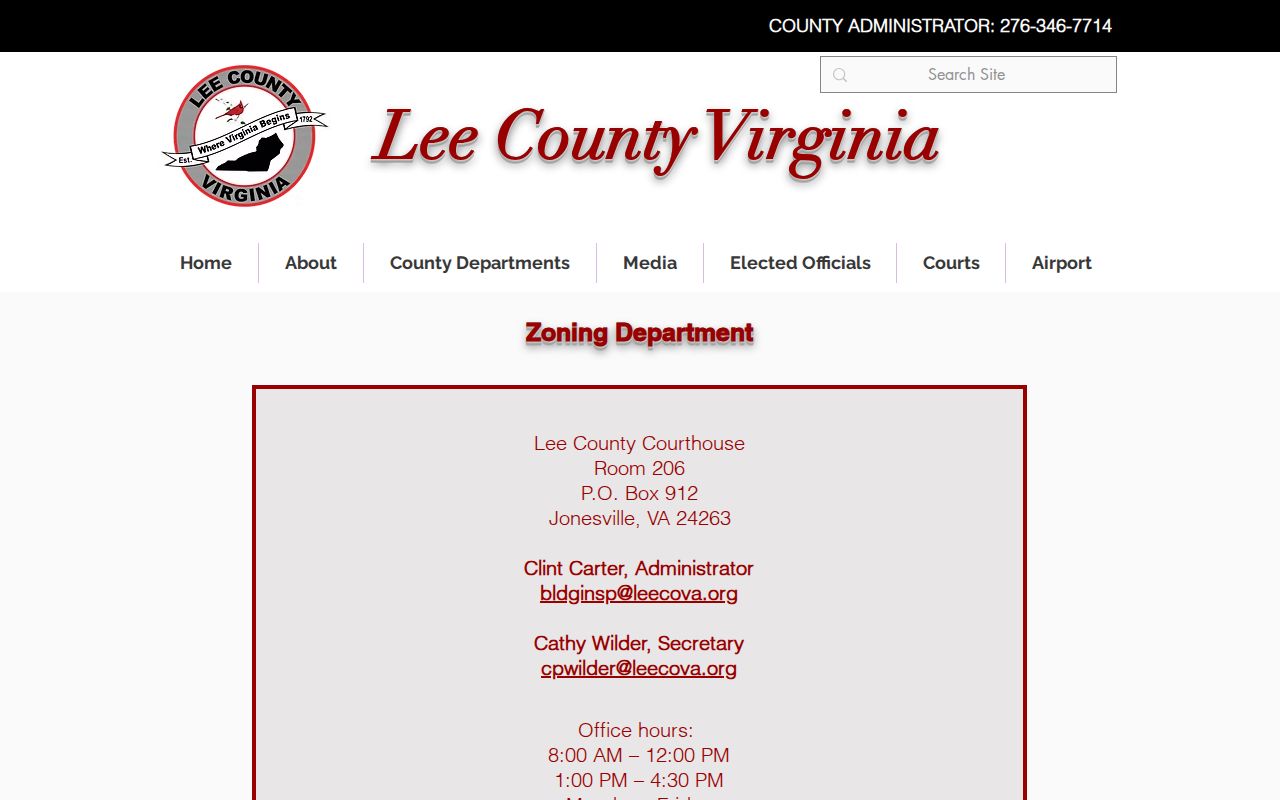
Permit and zoning pages list paper filing rules, not a public address search.
Lee County Tax Sale Notices
The Lee County Treasurer publishes a Tax Auction page with notices and images for delinquent-tax and special-commissioner sales. The page offers no searchable text list and states no coverage period, so treat any picture or notice as a lead. Call the Treasurer at (276) 346-7716 about a current sale list, parcel status, or redemption and payment questions.
Next, search the Clerk's land records for a tax lien, special commissioner deed, later conveyance, or release. Check circuit civil records where a case is involved. Match the parcel number and legal description; a similar street address is not enough. A notice guarantees no title, acreage, access, or continued sale status.
Use the Treasurer's tax-auction page as the first notice source.

Confirm any Lee County sale notice with the Treasurer and the recorded deed before acting on it.
Lee County's Former St. Charles Records
The name St. Charles lives on old maps. It is not a current incorporated town. Virginia Chapter 89 of 2022 ended the town, because it had stopped functioning and never held a charter under current law. All of its real, personal, and intangible property, along with its debt, vested in Lee County without a new deed. That documented event matters. Municipal references for St. Charles stop at 2022.
For parcels there, use Lee County sources. Turn to the assessment records, the county GIS map, and the deed records held by the Circuit Clerk. A ZIP code or the old town name can narrow a search. Neither one settles present boundaries. Jonesville and Pennington Gap remain the county's two incorporated towns, and neither keeps a separate recorder or assessor. The state act ending St. Charles town status is the legal source for the custody change.
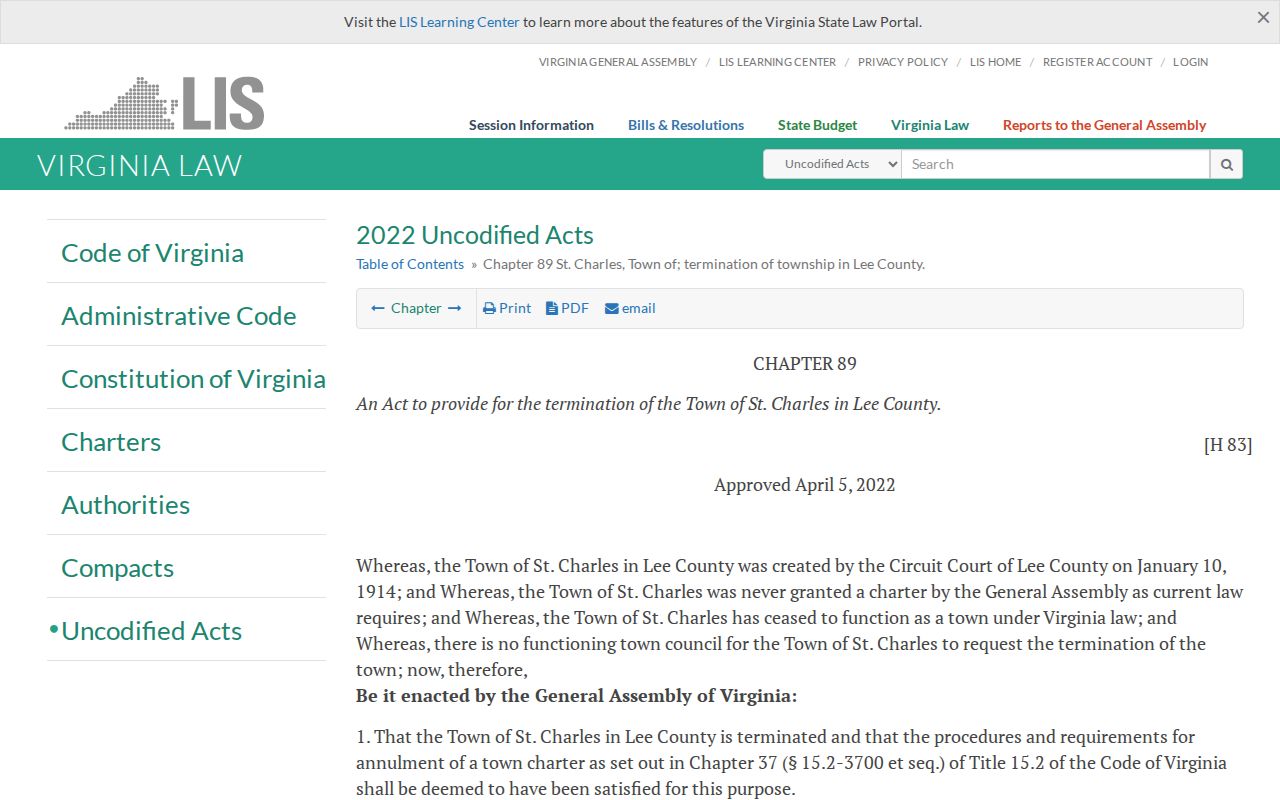
This custody rule points former town-property questions back to the county's current offices.
Requesting Lee County Records Under FOIA
Virginia FOIA covers records that never reach a portal. Describe the record with reasonable specificity and send the request to the public body that holds it. The custodian must respond within five working days. The options are providing the record, setting a production time, withholding it under a cited exemption, reporting that it cannot be found, or saying the office does not hold it.
No office has to create a new spreadsheet. Answering a broad research question is not part of the deal either. Charges can cover staff time, copies, postage, and redaction. Expect an advance deposit when the estimate exceeds $200. Inspection is often the cheaper route, so ask for it when it answers the question. Deeds belong with the Circuit Clerk, while tax and assessment files start with the Treasurer or the Commissioner. Permit records start with Building Safety or Zoning. Review the Virginia FOIA response and fee rules before sending a request.
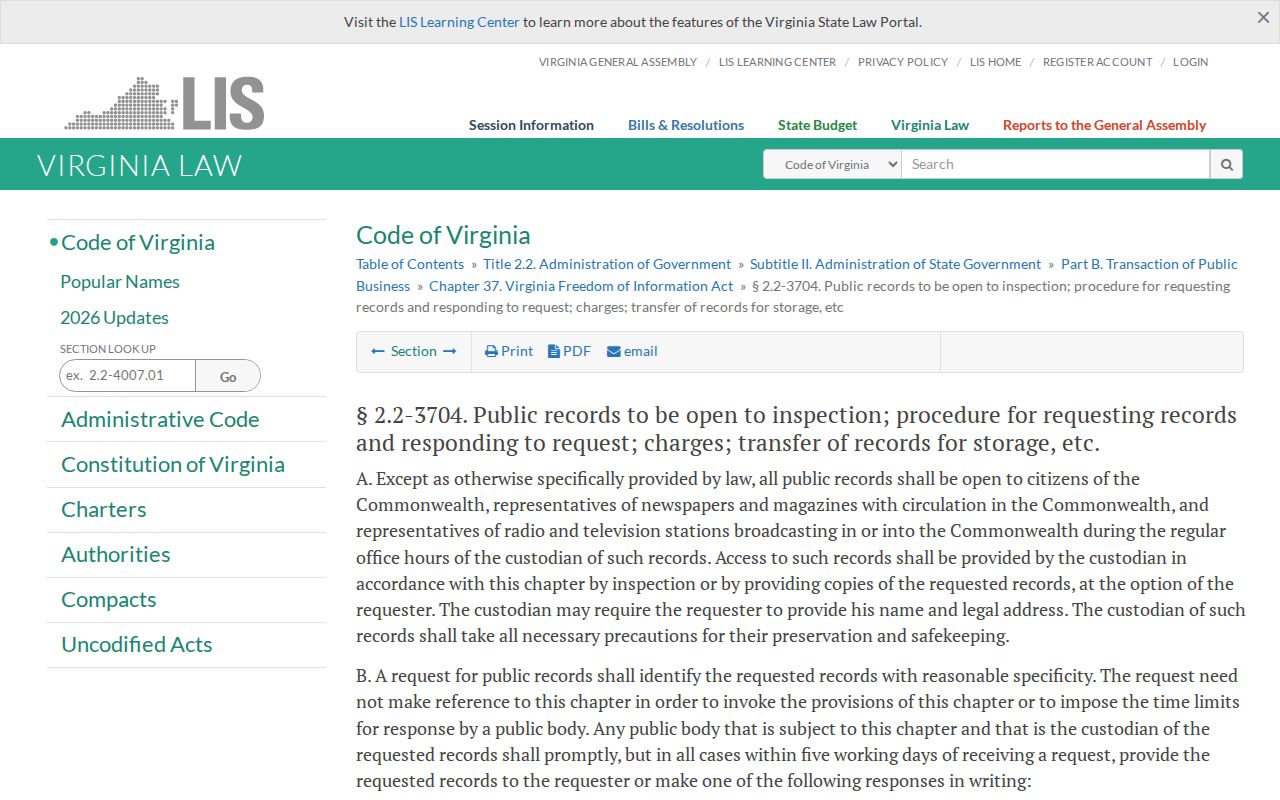
A FOIA request reaches the custodian. It cannot replace the clerk's deed index or the assessor's parcel key for a Lee County property search.
Limits of Lee County Property Records
Lee County property records show what a custodian recorded or assessed at a point in time. They can trace a deed. They can identify a parcel. They explain a tax bill or flag an approval file. On their own, they do not prove that every lien was released, that a mapped edge is a legal boundary, or that an assessed value equals a current sale price.
Lawful use. Use Lee County records for property diligence, tax questions, local history, and civic review. A search is not a title opinion or survey, and owner information must never be used to stalk, threaten, or harass anyone.